If you have a swimming pool in Florida, the fence around it is not just a design choice. It is a safety requirement written into state law. A pool fence is a barrier meant to keep young children from reaching the water unsupervised, and Florida takes that seriously. This guide gives you a general picture of what the rules look for so you know what to expect. It is not legal advice, and codes change and vary locally, so treat this as orientation and confirm the specifics before you build.
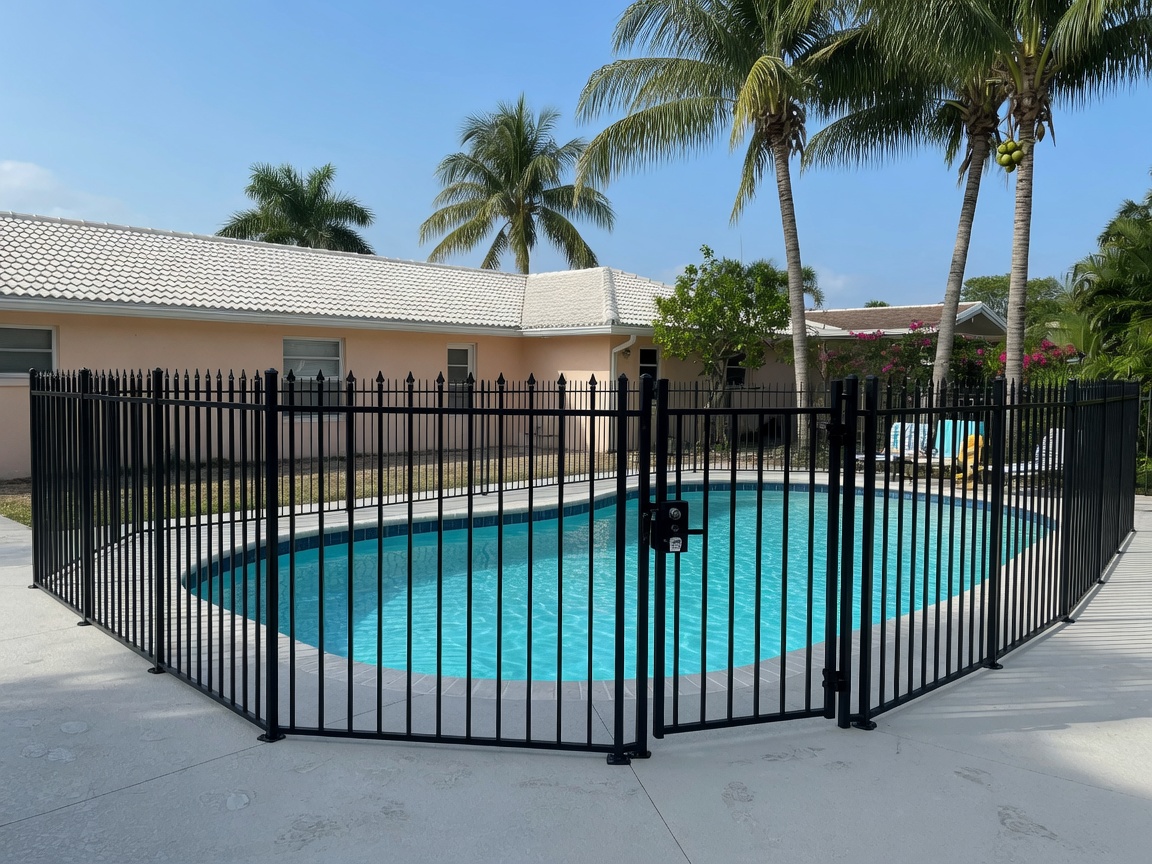
Verify before you build. The details below are described at a general level. Florida's residential pool safety rules live primarily in the Florida Statutes (the Residential Swimming Pool Safety Act, Chapter 515) and in the Florida Building Code, and your county or city may add its own requirements. Always check the current Florida code and your local building department, or have us pull the permit and build to today's standard, before relying on any summary, including this one.
Why Florida Requires a Pool Barrier
Florida's rule exists because of drowning risk to young children. The state's Residential Swimming Pool Safety Act requires residential pools to have at least one safety feature that restricts access to the water, and a fenced barrier around the pool is the most common way homeowners meet that requirement. The whole intent of the law is straightforward: make it hard for a small child to reach the pool unnoticed. Every specific rule below flows from that single goal.
The Barrier Basics
At a general level, the law describes a barrier that fully surrounds the pool and is built so a young child cannot easily get past it. In broad terms that means the barrier should be tall enough on the outside to be a real obstacle, and free of gaps, footholds, or gaps underneath that would let a child crawl under, squeeze through, or climb over. The state statute states a minimum outside height for the barrier and prohibits openings a small child could pass through, but exact height, spacing, and clearance figures are the kind of detail that is set by code and can change, so confirm the current numbers rather than trusting a figure you read online. The principle to remember is: continuous, hard to get past, and no easy footholds.
The Three Things a Barrier Has to Do
Strip away the specific numbers and the barrier rules come down to three plain jobs the fence has to perform, every foot of the way around the water.
Stay continuous
The barrier has to fully surround the pool with no break a child could slip through. A gap at a corner or a section left open for convenience defeats the whole purpose, so continuity is not negotiable.
Be a real obstacle
It has to be tall enough on the outside to be a genuine barrier rather than something a determined toddler can scramble over. The statute sets a minimum outside height, and the current figure is the kind of number to confirm with the code, not a summary.
No footholds on the outside
Horizontal rails or decorative features low on the outside face can become a ladder. A barrier is only as good as its least climbable spot, which is why the outside face has to stay smooth and hard to grip.
And nothing underneath
The clearance at the bottom has to be small enough that a child cannot crawl under. It is an easy detail to overlook on uneven ground, and an easy one to fail an inspection over.
Gates: The Self-Closing, Self-Latching Rule
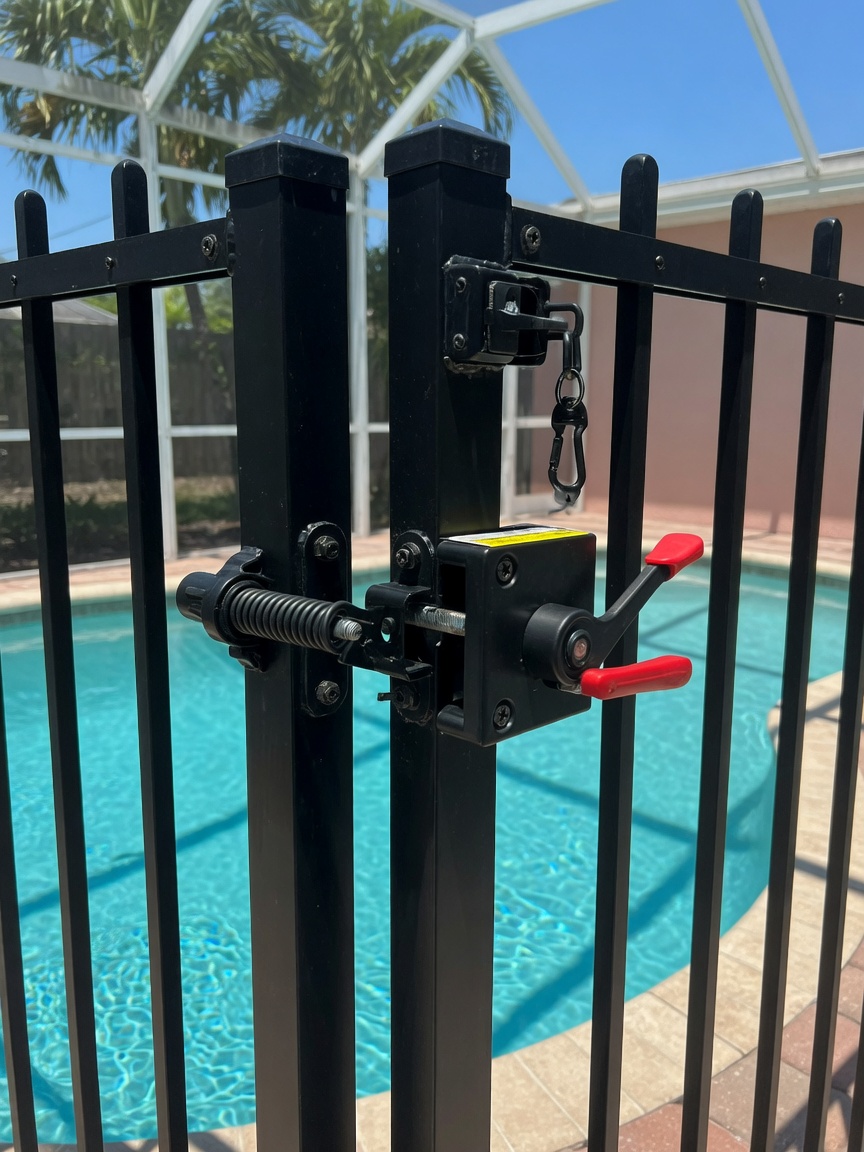
The gate is where the rules are most specific, because a gate is the barrier's weak point. Florida's statute calls for pool-barrier access gates to open outward, away from the pool, to be self-closing so they swing shut on their own, and to be self-latching so they lock without anyone having to remember to latch them. The statute also positions the latch release so a small child cannot easily reach it. In practice this is the detail that most often distinguishes a compliant pool fence from an ordinary one: the gate hardware has to do its safety job automatically, every time, whether or not an adult is paying attention.
Why the Gate Has to Work Without You
The whole logic of the gate rule is that safety cannot depend on a person remembering. A gate that a busy adult has to consciously close and latch will eventually be left open. A gate that closes and latches itself does not have that failure mode. That is why every part of the rule points at automatic behavior.
The hardware is the part to get right
When you shop for a pool fence, the self-closing hinge and the self-latching latch are the components that matter most. Ordinary gate hardware will not meet the rule, and hardware that works on install day but seizes up later is a problem waiting to happen, which is the coastal angle below.
Which Fence Materials Suit a Pool Barrier
Several materials can be built to meet safety-barrier requirements, and the choice usually comes down to the look you want and the coastal climate:
- Aluminum. Open-picket aluminum is a popular pool-barrier choice because it resists corrosion near water and salt air, and its vertical pickets are hard to climb while still letting you see the pool. Explore it on our aluminum and pool fence page.
- Vinyl and other panels. Solid or semi-open panels can serve as a barrier when built to the required height and clearance, giving privacy along with safety.
- Mesh and removable barriers. Some homeowners use purpose-built pool-safety fencing designed specifically to meet child-barrier requirements.
Whichever material you choose, the safety rules, meaning height, no footholds, and a self-closing self-latching gate, apply to how it is built, not just what it is made of.
Common Ways Homeowners Meet the Rule
The Residential Swimming Pool Safety Act lets a homeowner satisfy the safety requirement in more than one way, and a fenced barrier is only the most common. Knowing the landscape helps you pick the approach that fits your yard.
A Fence Around the Pool
A dedicated barrier fence around the pool itself is the approach most people picture, and it is what this guide focuses on. It isolates the water from the rest of the yard, which is the safest arrangement because the pool stays enclosed even when the back door of the house is open.
A Barrier at the Property Perimeter
Some homeowners rely on a compliant perimeter fence and gate that keeps the whole yard, pool included, enclosed. This can work, but it means the pool is only as protected as the yard, so any door from the house to that yard becomes part of the safety picture. The isolated pool barrier avoids that complication.
Whichever path fits your property, the safety rules govern how the barrier is built, so it is worth deciding the approach before you commit to a design.
The Coastal Angle
Near the water, corrosion is the quiet consideration on top of the safety rules. Salt air is hard on metal hardware, and a pool gate that has to close and latch itself every single time depends entirely on hardware that keeps working. That is why corrosion-resistant materials and gate hardware matter more for a coastal pool fence than an inland one, because a rusted self-latching hinge is both a safety problem and a code problem. Aluminum and corrosion-rated hardware earn their place here for exactly that reason.
Permits and Inspection
Because a pool barrier is a safety-code item, building or replacing one typically involves your local building department, and the work may be inspected to confirm it meets the barrier and gate rules. This is a place where knowing the current local code and pulling the permit genuinely pays off, and we build it to pass, so you are not discovering a problem at inspection. Rules can differ between counties and municipalities, so the local knowledge is not a formality; it is the point.
Getting a Pool Fence Quote Done Right
A pool fence is the one fence where "close enough" is not good enough, because it has to meet the safety rules, gate hardware included. The smartest move is to build the pool barrier to current code from the start. Show us your pool and yard once, and we will spec it right. As a fence company in Gulf Breeze, FL that regularly builds pool enclosures here, we know the local requirements and the corrosion-resistant hardware that lasts near the water. And remember: verify the current Florida code and your county's rules before you commit, because this guide is a starting point, not the final word.
Talk to us
Start on our fence company in Pensacola, FL or send us a quote request.
Aluminum & pool
The common pool-barrier material we build: aluminum & pool fences.
Salt-air hardware
Why coastal metal choices matter: aluminum & salt air.